
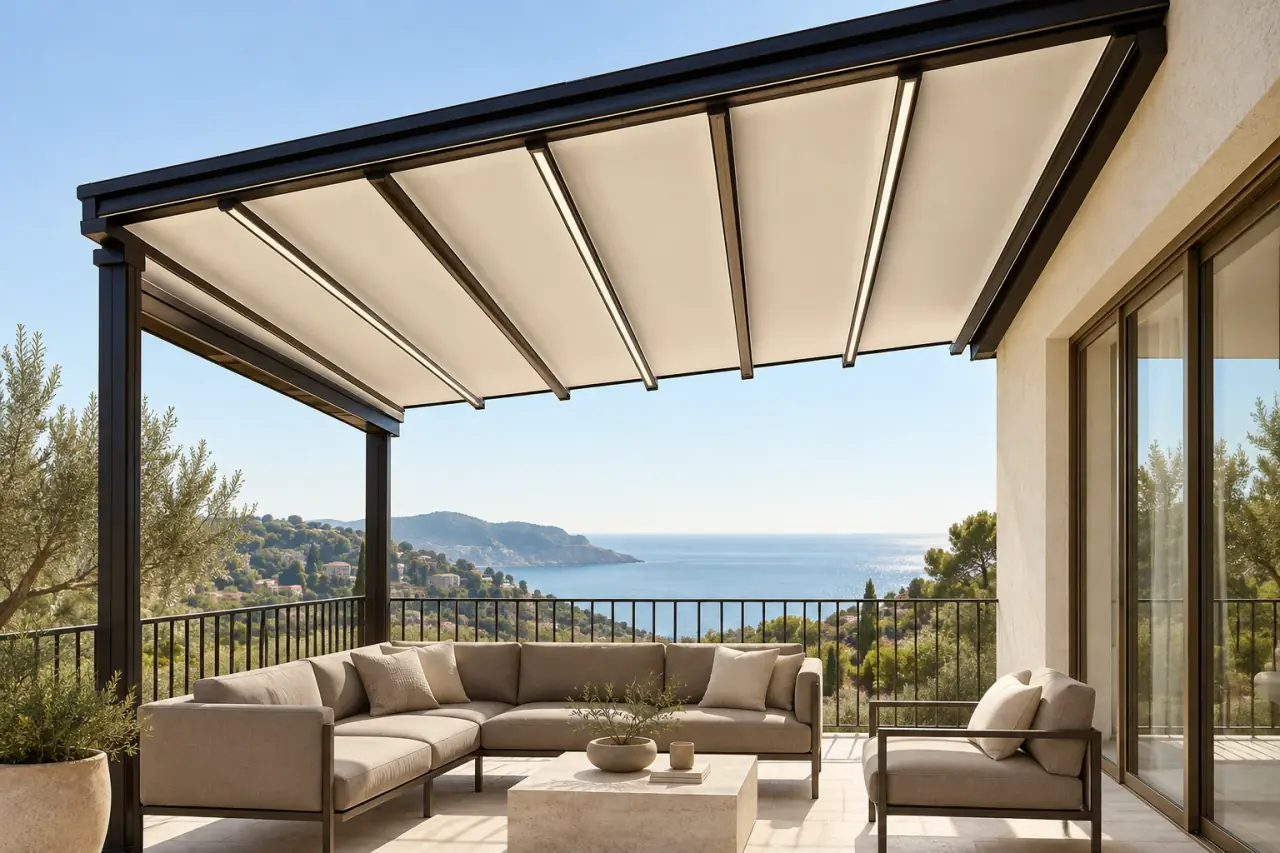
Do not decide from the fabric name, a weather icon or the presence of a wind sensor. Check the operating instructions for the exact awning, its dimensions and installation. Before ordering, separate two needs: shade on pleasant days and a terrace you expect to use during rain. This guide explains what to ask, what evidence to request and how to avoid buying a system for a use its documentation does not support.
Start with what you need the terrace to do
Write a short description of an ordinary day. A homeowner may be happy to move cushions indoors and stop using the patio when the weather changes. A café may want to keep serving customers, but should not treat every outdoor seat as available regardless of conditions. List the uses that matter, who will operate the cover and whether someone will be present. Send this brief before requesting a model. Ask the supplier to identify which requirements are supported, which require a different system and which remain unconfirmed. An attractive rendering cannot answer these operational questions.
A fabric description does not describe the whole roof
Sunbrella states that its fabrics range from water-resistant to waterproof. That distinction is a reason to request the exact fabric reference, not to attach one claim to an entire brand. For the complete installation, ask how the specification addresses fabric joins, edges, the wall connection and water discharge. Request the allowed operating positions and any required installation geometry in the selected system’s documents. Do not substitute a generic slope recommendation from another awning. This source is an example of why material identification matters; it does not establish that the quoted JYAVENRO system uses Sunbrella or has a particular rain rating.
A wind sensor is a control device, not a structural certificate
Somfy describes Eolis RTS as a sensor that retracts an awning in strong winds and has an adjustable threshold. That describes a control function. For your order, separately request the permitted use of the actual awning and confirmation that the motor, receiver and sensor are compatible. Ask who commissions the system and demonstrates its response. Do not choose the sensor setting from a general internet wind-speed chart or assume the same setting is appropriate for another size. If you need the terrace to remain in use when the awning must retract, that is a project requirement to resolve before buying, not a reason to override the control.
Explore this topic: Motorized awning enquiries: voltage, controls and service details
Trace the water route on the installation drawing
Mark where water is intended to leave the cover and what is underneath that point. Ask the designer to check the doorway, the route to the garden, furniture and any neighbouring property affected by discharge. Where gutters and downpipes are proposed, show the final connection as well as the visible roof components. Do not assume that the supplier’s scope includes ground drainage simply because a gutter appears in the rendering. Record who confirms the outlet and who carries out the connection. This drawing review is a coordination step: it does not calculate drainage capacity or establish performance in a particular storm.
Explore this topic: Folding roof posts and gutters: coordinate drainage before paving
Compare the options against the same requirement
Ask each supplier to respond to the same brief: desired use, available wall, permitted posts, usable height, drainage route and operating conditions. A different roof type may solve one problem while changing the support layout, maintenance access or cost. Request a drawing showing the usable space when the cover is open and when it is closed. For a café, add the tables and service route; for a home, add doors and the seating area. Avoid comparing a supply-only awning price with an installed roof system. Keep unconfirmed requirements visible rather than assuming the more expensive proposal automatically meets them.
What to confirm before paying a deposit
Keep the model and dimensions, approved drawing, operating instructions, included controls and installation responsibilities together. Ask the supplier to identify the document that supports any advertised weather claim. Where evidence is missing, request clarification rather than turning a sales phrase into your own operating rule. At handover, have the installer explain the approved response to changing weather and how to contact service if movement is abnormal. Do not use this article as a wind-speed table or a storm procedure. Its purpose is to help you obtain the correct instructions before you depend on the installation for everyday use.